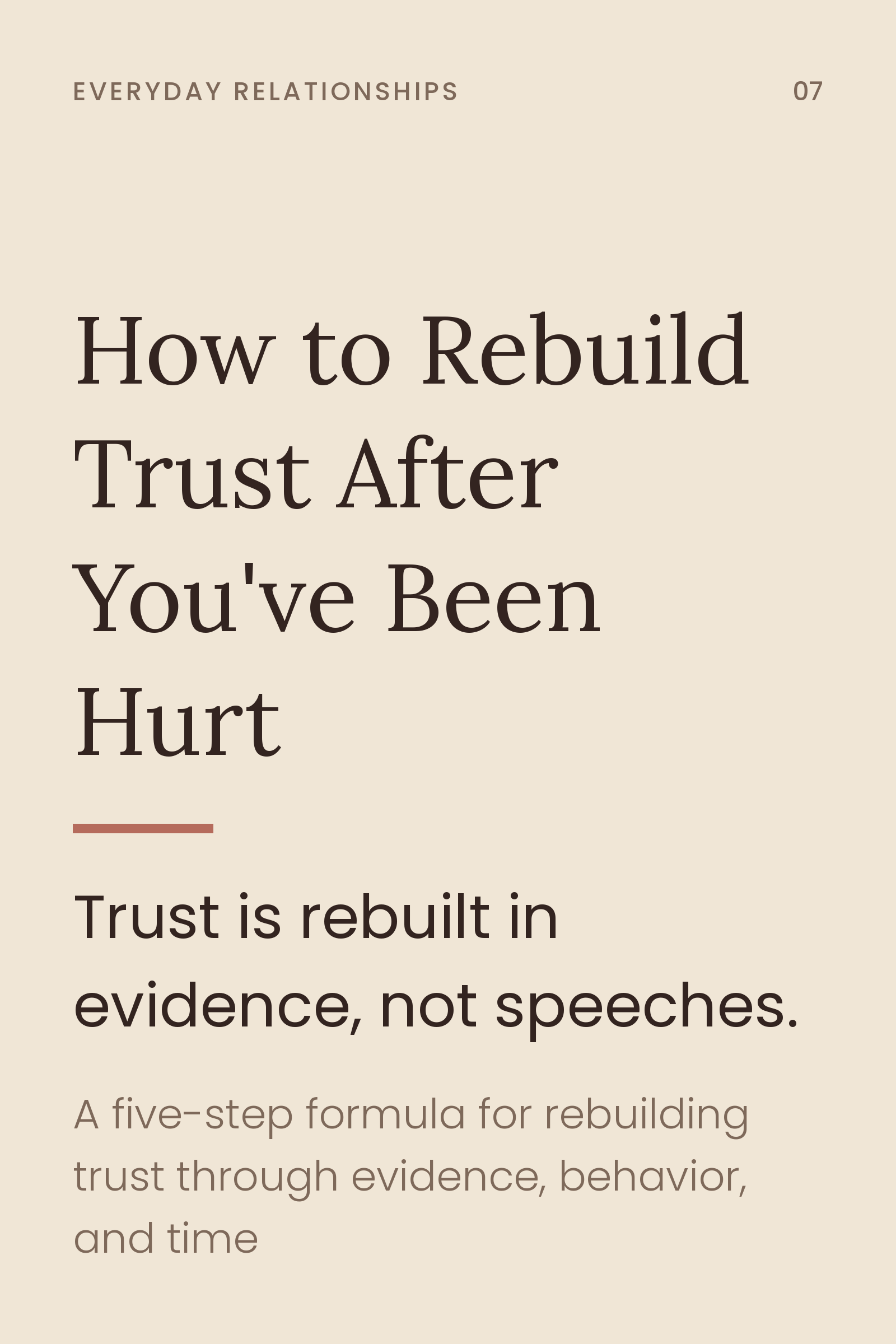
How to rebuild trust after you’ve been hurt

$7.99

Trust Is Rebuilt in Evidence, Not Speeches

After betrayal, dishonesty, broken promises, or repeated disappointment, people often ask, “How do I trust again?” Trust is not a switch you force back on. It is a judgment that can be rebuilt gradually when words, behavior, accountability, and time begin matching again.

The trust-rebuildina formula

  1. Name the breach. What specific trust was damaged?
  2. Establish the facts. Is the basic story stable and truthful?
  3. Define repair. What observable behavior needs to change?
  4. Restore gradually. Match access and responsibility to current evidence.
  5. Review the pattern. Trust grows when consistency survives ordinary life, not only the crisis.

REAL-LIFE SITUATION

The apology pressure

Someone says, “I apologized, so why do you still not trust me?”

WHAT TO DO

Separate accepting an apology from restoring confidence.

WORDS YOU CAN USE

“*l appreciate the apology. Trust will take consistent behavior over time.””

PRACTICAL STEPS

  • Name the exact trust breach.
  • Separate apology from evidence.
  • Define one repair behavior.
  • Review what happens over time.

COMMON MISTAKE

Treating an apology as automatic proof of change.

ONE QUESTION TO ASK YOURSELF

What exact kind of trust was broken ?

Description

CHAPTER 1

What Exactly Was Broken?

Trust is not one thing. You may trust someone to love you but not handle money, keep a secret, tell the truth, arrive on time, remain faithful, or protect your interests. Name the specific kind of trust that was damaged.

REAL-LIFE SITUATION

The wrong category

A friend is wonderful emotionally but repeatedly fails to repay borrowed money.

WHAT TO DO

Name the exact area where trust is weak instead of declaring the entire person trustworthy or untrustworthy.

WORDS YOU CAN USE

“*] care about our friendship, but I am not comfortable lending money again.'”

PRACTICAL STEPS

  • Use specific facts.
  • Ask only decision-relevant questions.
  • Restore access gradually.
  • Do not force emotional certainty.

COMMON MISTAKE

Demanding instant total trust or total distrust.

ONE QUESTION TO ASK YOURSELF

What evidence would make me reasonably safer trusting again ?
Content Preview 1

CHAPTER 2

Do Not Rush Past the Facts

Before rebuilding, understand what happened as accurately as reasonably possible. Healing becomes harder when the story keeps changing or important facts continue appearing later.

REAL-LIFE SITUATION

The changing timeline

Important details about what happened keep appearing after you thought you knew the full story.

WHAT TO DO

Do not rush into repair until the basic facts are reasonably stable.

WORDS YOU CAN USE

“”| need an accurate picture before I can decide what rebuilding trust requires.””

PRACTICAL STEPS

  • Match the repair to the injury.
  • Look for consistent follow-through.
  • Notice how setbacks are handled.
  • Adjust trust to current evidence.

COMMON MISTAKE

Using endless surveillance as the permanent definition of repair.

ONE QUESTION TO ASK YOURSELF

Am I reacting to a promise or to a sustained pattern ?