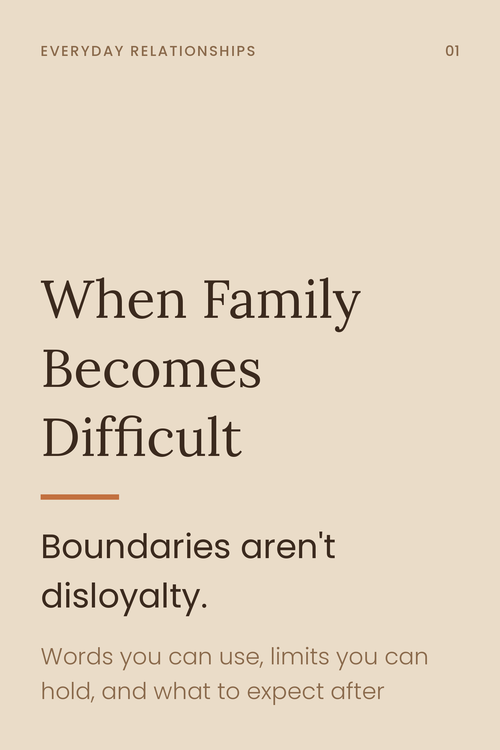
When family becomes difficult

$7.99

Family Can Be Loving and Difficult at the Same Time

Family relationships carry history. The person upsetting you today may also be the person who raised you, grew up beside you, helped you through a crisis, or has known you longer than almost anyone. That history can make ordinary boundaries feel disloyal. This guide is about finding a healthier middle ground between endless tolerance and unnecessary war.

A better goal than “fixing the family”

You cannot control whether every relative becomes reasonable, apologizes, changes, or understands you. A more useful goal is to become clearer about what you will participate in, what you will help with, what you will keep private, and what you will do when a limit is ignored.

REAL-LIFE SITUATION

A familiar moment

You leave a family call feeling drained, then immediately criticize yourself for being upset because “they are family.”

WHAT TO DO

Write the event without interpretation: “I said I could not visit Saturday. I was called selfish three times and the call continued for twenty minutes.” Facts make patterns visible.

WORDS YOU CAN USE

“I care about our relationship, and I need this conversation to stay respectful.”

PRACTICAL STEPS

  • Notice whether you are solving a current problem or defending your entire character.
  • Decide your limit before the conversation when possible.
  • Use one clear sentence instead of five explanations.
  • Watch what happens after the boundary; response patterns are useful information.

REMEMBER

You do not have to prove someone is a bad person before taking your own distress seriously.

ONE QUESTION TO ASK YOURSELF

What part of this situation is actually under my control ?

Description

CHAPTER 1|

Stop Asking Whether You Are Allowed to Be Bothered

Family problems often begin with self-doubt. Instead of deciding whether you are allowed to feel upset, describe what is happening: what was said or done, how often it happens, what effect it has, what you requested, and what happened when you said no.

REAL-LIFE SITUATION

The family role

You have always been the person who fixes everyone’s problems. The first time you say, “I cannot handle this one,” relatives act shocked.

WHAT TO DO

Expect the system to push back. Repeat the new limit and resist proving your goodness by rescuing again.

WORDS YOU CAN USE

“I understand you are disappointed. My answer is still no.”

PRACTICAL STEPS

  • Name the role you are leaving.
  • Expect others to prefer the old version of you.
  • Practice tolerating disappointment without immediately fixing it.
  • Measure progress by consistency, not by whether everyone approves.

REMEMBER

Resistance does not automatically mean the new boundary is wrong. It may mean the old role was useful to other people.

ONE QUESTION TO ASK YOURSELF

What am I afraid will happen if I stop playing my usual family role ?
Content Preview 2

CHAPTER 2

Old Family Roles Follow Us Into Adulthood

Families often assign roles: the responsible one, peacemaker, difficult one, successful one, baby, or rescuer.

Years later everyone may still expect you to perform the same role. Changing it can create resistance before it creates a healthier pattern.

REAL-LIFE SITUATION

The guilt request

A relative says, “After everything I have done for you, you owe me this.”

WHAT TO DO

Separate appreciation from the present request. Decide what you can reasonably do before responding.

WORDS YOU CAN USE

“I am not discussing that private matter.”

PRACTICAL STEPS

  • Ask what is truly your responsibility.
  • Ask what belongs to another capable adult.
  • Choose help you can sustain without resentment.
  • Do not use guilt as the only decision-making tool.

REMEMBER

“I appreciate what you have done for me. I still cannot take this responsibility on.”

ONE QUESTION TO ASK YOURSELF

If guilt were not making the decision, what would a reasonable responsibility look like ?