Description
CHAPTER 1|
One Painful Mistake or a Repeating Pattern?
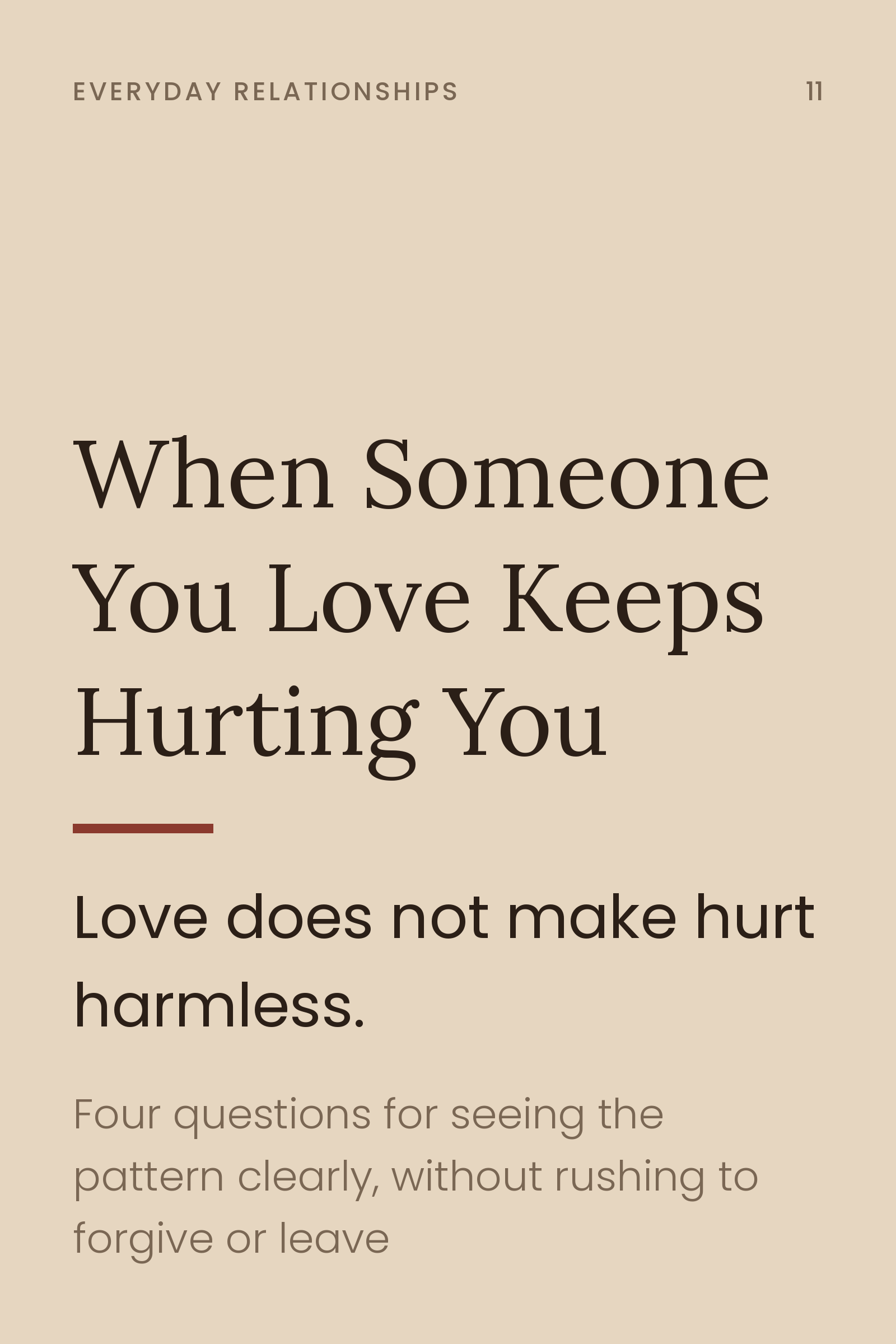
Everyone disappoints people they love sometimes. The important distinction is whether the harm is occasional and repaired, or repeated despite conversations, apologies, and promises. Patterns deserve more weight than isolated moments.
REAL-LIFE SITUATION
The rare mistake
Someone says something hurtful, quickly owns it, apologizes without excuses, and changes the behavior.
WHAT TO DO
Notice repair as well as injury. A healthy relationship is not one where nobody makes mistakes; it is one where mistakes can be repaired.
WORDS YOU CAN USE
«”Thank you for taking that seriously. That helps me move forward.”‘
PRACTICAL STEPS
- Separate explanation from excuse.
- Name what belongs to you.
- Name what belongs to them.
- Choose the next action you control.
COMMON MISTAKE
Believing understanding someone’s pain requires accepting their behavior.
ONE QUESTION TO ASK YOURSELF
Am I evaluating what happened—or explaining why I should tolerate it ?
Content Preview 1
CHAPTER 2
Why We Excuse More From People We Love
History, loyalty, attraction, family ties, shared children, gratitude, dependence, and hope can make us explain away behavior we would recognize immediately in someone else. Understanding why you stay is more useful than shaming yourself for staying.
REAL-LIFE SITUATION
The excuse list
You keep explaining their behavior: stress, childhood, work, alcohol, loneliness, bad luck.
WHAT TO DO
Context can explain behavior without making its impact disappear. Ask what the pattern is doing to your life.
WORDS YOU CAN USE
“”‘I can understand why you are struggling and still need this behavior to stop.””
PRACTICAL STEPS
- Ask what has actually changed.
- Look for consistency after the crisis.
- Set one measurable boundary.
- Review behavior after enough time to see a pattern.
COMMON MISTAKE
Treating another apology as evidence before behavior changes.
ONE QUESTION TO ASK YOURSELF
What evidence would I need to see before / call this real change ?