Description
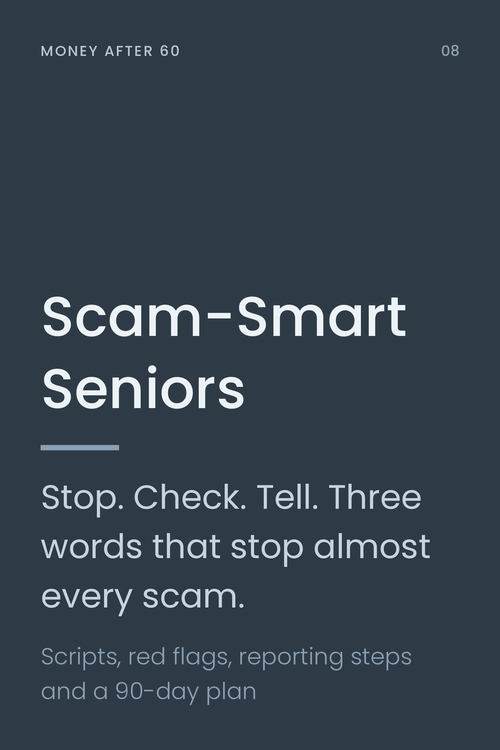
Guide teaches a simple rule that works under pressure: Stop. Check. Tell. Learn how to recognize phone scams, phishing messages, fake bank alerts, government impersonators, Medicare and Social Security scams, family-emergency and AI voice scams, romance scams, investment and crypto fraud, prize and charity scams, identity theft, and financial exploitation by someone you know.
Inside, readers will find:
– Clear red flags that expose pressure and manipulation
– Safe scripts for ending suspicious calls and messages
– Immediate steps for gift cards, wire transfers, payment apps, account takeovers, and identity theft
– Practical tools for safer passwords, banking alerts, social media, and family verification plans
– A reporting roadmap for the FTC, IdentityTheft.gov, IC3, Social Security OIG, Medicare, and local help
– Fill-in worksheets, trusted-contact lists, and a 90-day scam-protection plan
– A California Adult Protective Services note for readers who need local assistance
Content Preview 1
How Scams Work and Why Good People Fall for Them
A scam is not simply a bad deal or a confusing sales pitch. It is an effort to use deception to get your money, personal information, account access, or help moving money. Scammers study what gets attention. They know that people worry about a bank account, Medicare, Social Security, a grandchild, a package, a bill, a health problem, or a chance to earn a little more in retirement.
Scams usually follow a pattern
Most scams include four parts:
1. A hook. A message says there is a problem, a reward, an emergency, or a special opportunity.
2. Pressure. The person says you must act now, stay on the phone, keep it secret, or avoid talking to your bank or family.
3. A payment or access request. You are asked for gift cards, a wire transfer, cryptocurrency, a payment-app transfer, cash, a bank login, a Medicare number, a Social Security number, or a one-time security code.
4. Isolation. The scammer keeps you busy so you do not independently verify the story.
Content Preview 2
The Stop. Check. Tell. Method
A complicated anti-scam plan is hard to remember when a phone is ringing. This three-step method works because it gives you an action before you need to decide whether the story is true.
Stop
Stop means do not take the next irreversible step. Do not send money. Do not read a verification code aloud. Do not click a link. Do not open a surprise attachment. Do not install software. Do not hand over a card or document. Do not let someone remotely control your phone, tablet, or computer.
You can end a call politely. You can close a window. You can delete a message. A real bank, government office, doctor, or family member will still be available after you pause.
Check
Check through a path you control. Do not use the phone number, web link, QR code, or email address in an unexpected message. Instead:
- Call the number printed on the back of your bank or credit card.
- Type the official website yourself into a browser.
- Use an app you already installed from an official source.
- Call a family member using a number you already have.
- Ask a pharmacy, clinic, plan, or government office using its published contact information.
Caller ID is not proof. A sender name is not proof. A logo is not proof. Independent contact is proof.